November 13
Technology is evolving rapidly. For businesses, the key question is: How can technology help us work more efficiently, stay secure and prepare for what’s next? The Ionic IT team attended Pax8 Beyond 2026 EMEA in Copenhagen to explore exactly that.
The annual event brings together IT providers and technology partners to discuss the latest developments shaping the industry, from artificial intelligence to cyber security and the future of managed IT services.
In this article, we share seven key takeaways, what they mean for businesses and how managed IT services can help organisations adapt, stay secure and make better use of technology
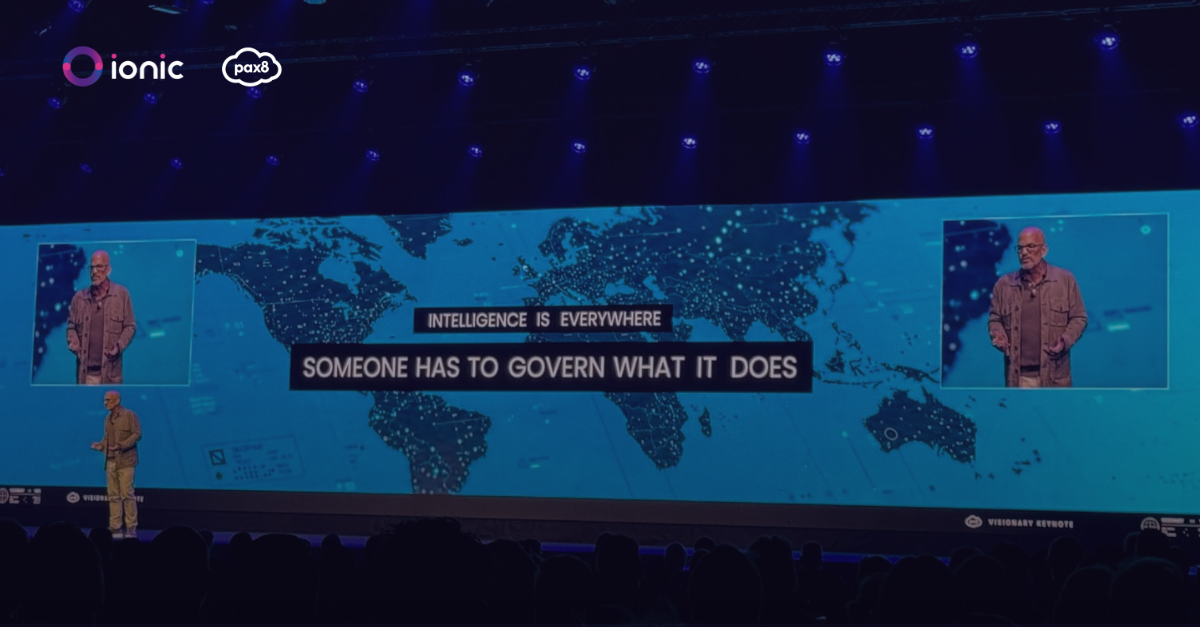
1. Managed IT services should combine business goals with reactive IT support
When businesses think about IT support, they often assume it only includes fixing issues, responding to tickets, and keeping their systems running. Those things matter. But a good managed IT services partnership should look ahead and plan for what’s next.
For example, a business could be happy with how quickly its IT issues are resolved from their managed IT service provider but still need support with how their technology feeds into bigger business goals.
- To work out how technology feeds inro your businesses future plans, ask:
- Are our systems helping staff work efficiently, or are they creating unnecessary delays?
- Do we understand the cyber risks facing our business and how we are protected?
- Are we making the most of the technology we already pay for?
- Will our IT continue to meet our needs as the business grows or changes?
One of the sessions at the Pax8 Beyond 2026 event on strategic account management encouraged managed IT service providers to look beyond tickets and service statistics and start customer reviews with business goals.
“For an MSP to survive, their clients need to thrive.” – Limara Thorne, Senior Strategic Consultant, Pax8.
The most valuable IT reviews with your managed IT service provider should create space for these conversations. Your regular IT review should include:
- Your business goals and what you want to achieve over the next year and months.
- Identify any gaps or risks in your current systems, security and ways of working.
- Look at the technology you have and where you can get more value from it.
- Agree on clear IT priorities and next steps, so you know what needs to be done, who is responsible and when.
Ionic’s takeaway – Managed IT services should support where a business wants to go, as well as where it is today.
2. AI needs a clear business purpose and the right foundations
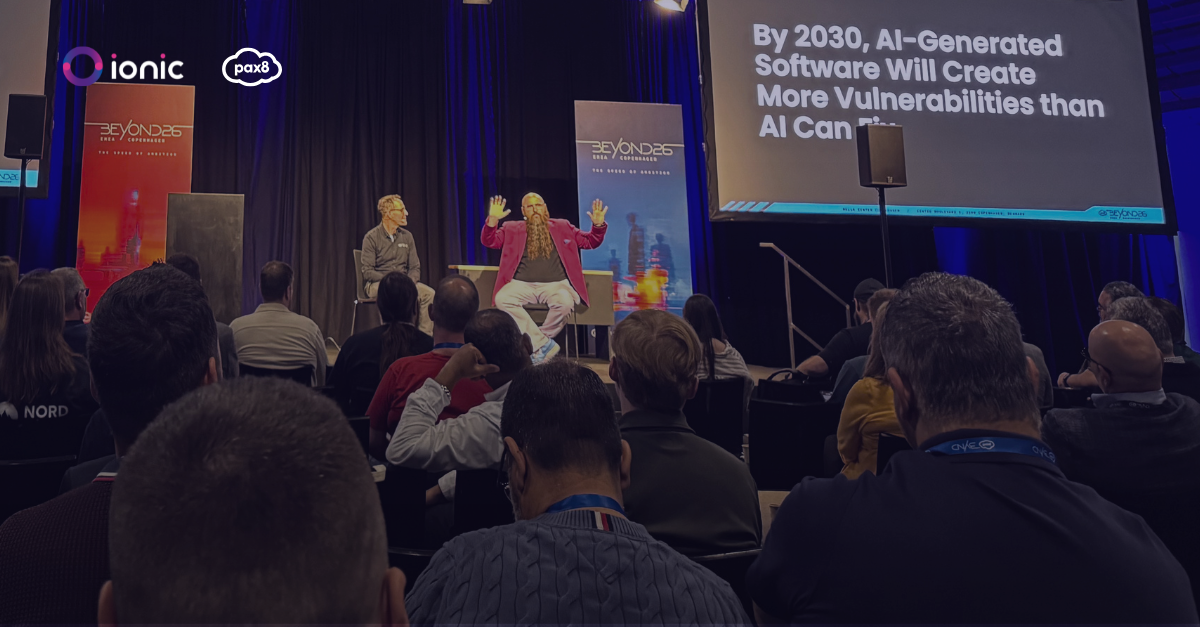
Pictured – Cybersecurity Experts, Mostyn Thomas and Matt Lee Speaking at Pax8 Beyond EMEA
AI was a major topic throughout Pax8 Beyond 2026, reflecting its growing role in business and managed IT services. This is supported by the World Economic Forum’s Future of Jobs Report found that 86% of employers surveyed worldwide expect AI and information processing technologies to transform their business by 2030.
Closer to home, a survey by Galvia Digital and The Belfast Chamber found that 83% of business respondents across Northern Ireland are already using AI tools. Yet 73% have no formal AI policy in place at the time of the survey.
The study captured responses from 211 participants representing 202 organisations across Northern Ireland, ranging from sole traders and micro businesses to large employers with more than 100 staff.
The responses highlight a common ‘adopt AI first, plan later’ pattern and a requirement for stricter governance on how business data is used and support to use and secure AI.
Find out how AI is used across the business
Our overall takeaway in terms of AI usage is that businesses should start with the problems they want to solve before introducing AI more widely. To help you, Ionic’s AI Adoption Strategy Toolkit includes a ready-to-send staff survey you can duplicate to find out:
- Which repetitive tasks take up the most time and could be suitable for AI support.
- Where staff think AI could help them review information, such as data and spreadsheets.
Starting with a clear AI use case makes it easier to assess whether AI is delivering value before investing heavily in the technology. The Pax8 event also raised important questions about how AI is used in businesses, such as:
- Are your employees using personal accounts?
- What business information can an AI tool access?
- How does AI store the business information inputted?
- Who is responsible for checking its output?
- Are employees using approved tools, and do they understand what information they can share
Standardise and secure the AI tools used
Speaking at Pax8 Beyond EMEA, cybersecurity experts Matt Lee and Mostyn Thomas warned about the permissions businesses give to AI agents and the need for human oversight.
“Don’t give AI tools your identity. Have a separate identity you track and delegate.”
Matt Lee, Security and Compliance Senior Director Pax8.
An AI agent is a tool that can carry out tasks using connected systems. Giving it a separate identity makes it easier to see what it can access and manage its permissions.
The connection of AI agents to business systems raises concerns. This was showcased in a live session poll, where the audience in attendance was asked:
“Which of five listed responsibilities they would trust an AI agent with first?”
52% of respondents chose “none of them”. Only 7% said they would trust an AI agent with their domain administrator access as little as 3% trust for £10,000 purchasing authority.
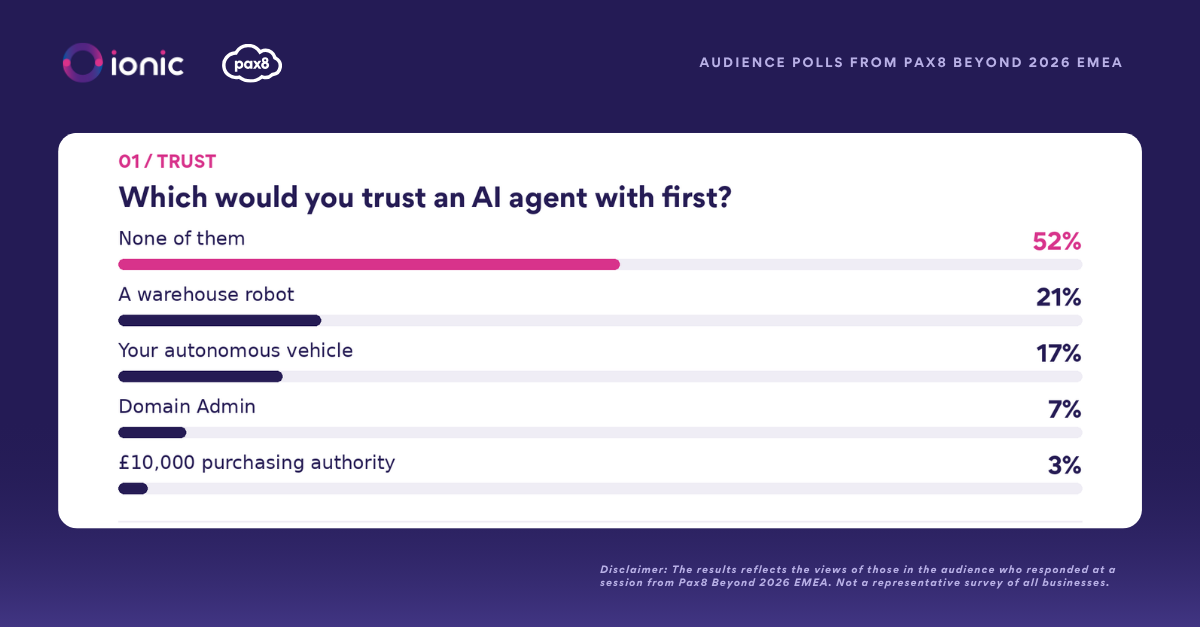
Audience poll results on AI agent trust from Pax8 Beyond 2026 event
The results of the survey on AI trust highlight why clear limits, human oversight and building confidence matter when introducing AI across a business.
It also raises further questions for businesses. If you wouldn’t trust an AI agent with your domain admin, why are some letting it read their personal emails and business sensitive data?
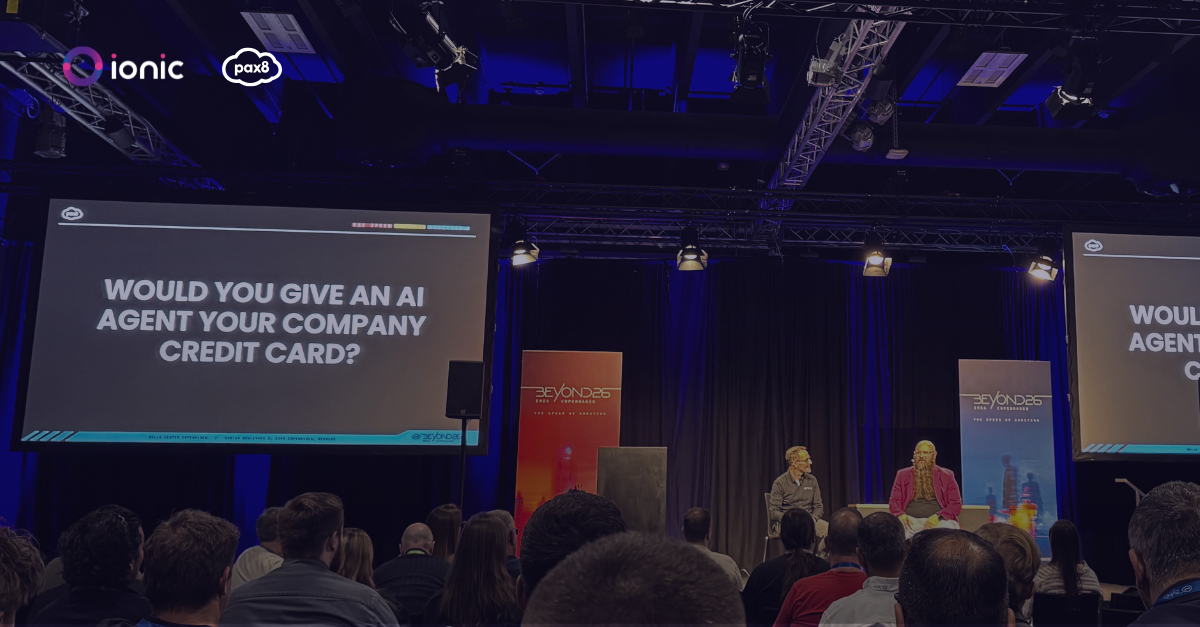
As AI tools become more capable of taking actions on behalf of users, those questions become even more important. Businesses need a clear AI adoption strategy, that covers:
- AI ownership
- Appropriate AI access
- Approved AI use cases
- Human oversight
In response to these findings to help businesses adopt AI clearly, we’ve created an AI Adoption Strategy Toolkit. This AI toolkit is packed with editable templates to help businesses:
- Survey staff on current AI use
- Use the survey responses to identify AI opportunities
- Secure and lock down approved AI tools
- Assign AI champions to motivate staff to embrace AI
- Create an AI roadmap to structure key steps and track findings
- AI champion certificates to award staff using AI correctly
Keep humans accountable for how AI is used
Matt Lee, Security and Compliance Senior Director at Pax8, stressed in one of the sessions that keeping humans ‘in the loop’ on AI usage does not go far enough. Businesses need to be aware and retain oversight of automated AI and accept responsibilities for their consequences.
“You are also responsible for the outcomes of AI, and you are also need to own those outcomes not only as a human, but also as a company,”
Matt Lee, Security and Compliance Senior Director Pax8
Matt predicted in his talk that by 2030, businesses will face greater pressure to explain why an AI system behaved as it did and what safeguards were in place.
By 2030, he predicted that organisations may face greater pressure to explain why an AI system behaved as it did and what safeguards were in place.
Ionic’s takeaway – Start small, choose a practical AI use case and make sure the right data and security measures are in place before expanding.
3. Cyber security is about more than protecting devices
Protecting laptops, desktops, and other devices remains an essential part of managed IT services. But a big emphasis as the Pax8 Beyond 2026 event was that modern cyber security also needs to consider the people, accounts, applications and information connected to a business.
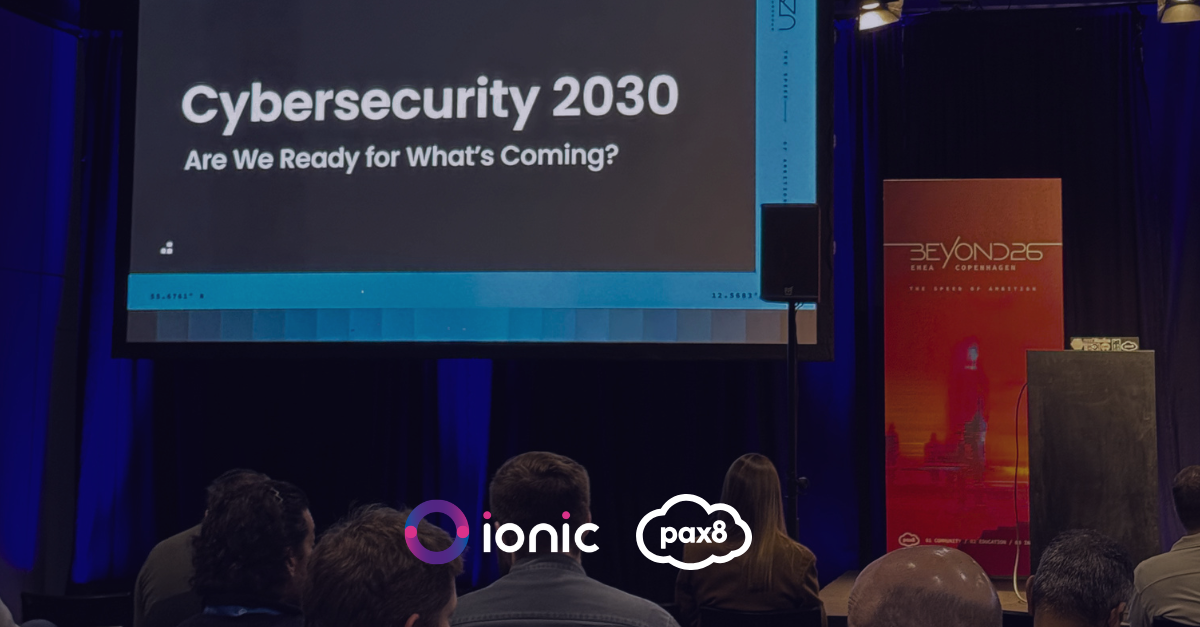
An attacker who gains access to a legitimate account may be able to move through systems without relying on a compromised device. Similarly, as businesses introduce new applications and AI tools, they need to understand what those tools can access and who is responsible for them.
The growing importance of protecting both systems and information is reflected by the spike in cyber attacks in 2025 and 2026. The UK Government’s 2025/26 Cyber Security Breaches Survey estimated that UK businesses experienced 5.19 million cyber crimes in the preceding 12 months, the majority involving phishing.
These attacks can be used to trick employees into revealing information or account details, making it easier for attackers to gain access. This highlights why the future of managed IT services must include ongoing security monitoring, access management and planning for how businesses respond to an incident.
Showcasing the changing cyber landscape, several well-known businesses In October 2026, ASOS reported that an attacker gained access to an employee account by impersonating a trusted contact. The same month, Hobbs, Whistles and Phase Eight were affected by cyber incidents that disrupted some IT systems and website functions.
The rise in cyber attacks highlight why the future of managed IT services must include ongoing security monitoring, access management and planning for how businesses respond to an incident
Furthermore, an event poll at the Pax8 event also asked what worried respondents in the audience about 2030 in terms of AI and cyber challenges. The largest group, 38%, chose not knowing whether a human is actually human, as shown in the results below.
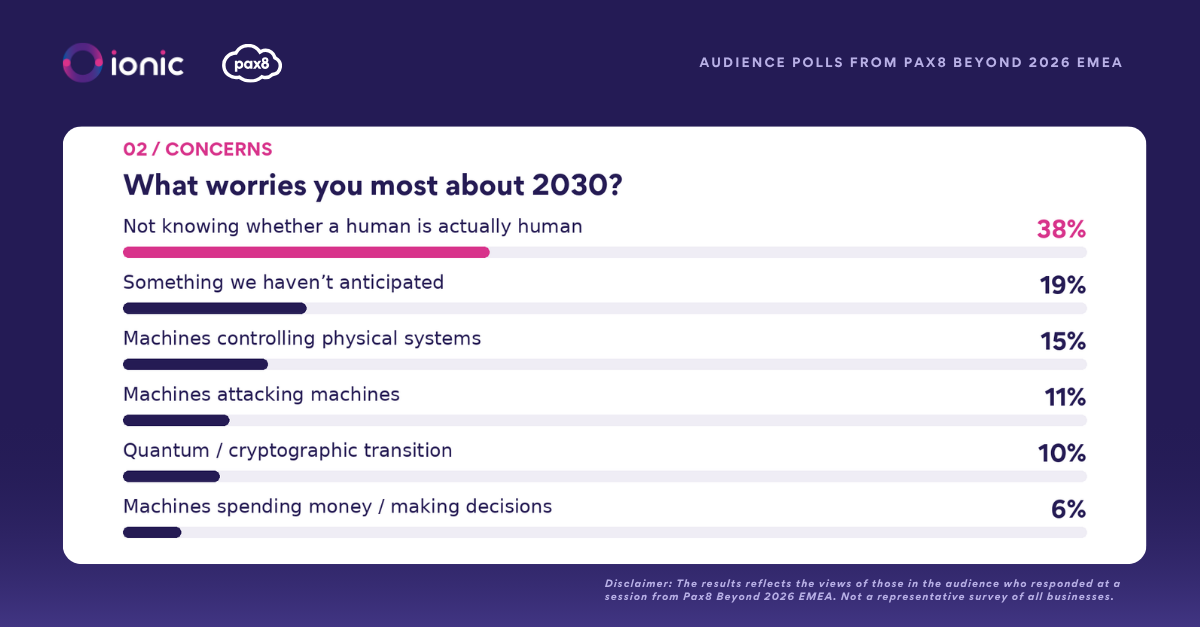
The AI and cyber concerns raised at the Pax8 event are a reminder to consider how staff verify unusual requests as AI-generated impersonation becomes more convincing.
For business leaders, this doesn’t mean understanding every technical setting. Review you cyber security with your managed IT service provider by asking:
- Who has access to sensitive information? Including external partners.
- Do people still need the access they have?
- How are unusual account activities identified?
- Have we considered the permissions given to connected applications and AI tools?
These questions can help make cyber security part of everyday decision-making, rather than something considered only when a problem occurs.
Ionic’s takeaway: Knowing who and what has access to your business information is an essential part of managing cyber risk.
4. A cyber incident tests human communication as well as technology
No business wants to experience a cyber incident. Planning how to respond can help teams make decisions quickly if an attack happens.
At one of the Pax8 sessions, Adam Pilton, Cybersecurity Advisor at Heimdal Security with 15 years experience in law enforcement, discussed decision-making during a data breach. He highlighted the importance of leadership, communication and preparation alongside technical response.
“The organisations that do succeed are the ones that are ready for cyber incidents.”
Adam Pilton, Cybersecurity Advisor, Heimdal Security.
Form a cyber-attack response plan
A key takeaway from the event for Managed IT Services to discuss with clients is. “If your business suffered a cyber-attack, do you have the answers?” Consider:
- Who will make the key decisions on how the business reacts?
- How will employees and customers be kept informed of the incident?
- How will the team communicate if their usual systems are unavailable?
It’s important to build a cyber attack response plan with key people in your business involved that understand it and have had an opportunity to practise.
A real example shared at Pax8 Beyond was the British Library cyber attack in 2023, which highlighted the importance of clear decisions and communication under pressure.
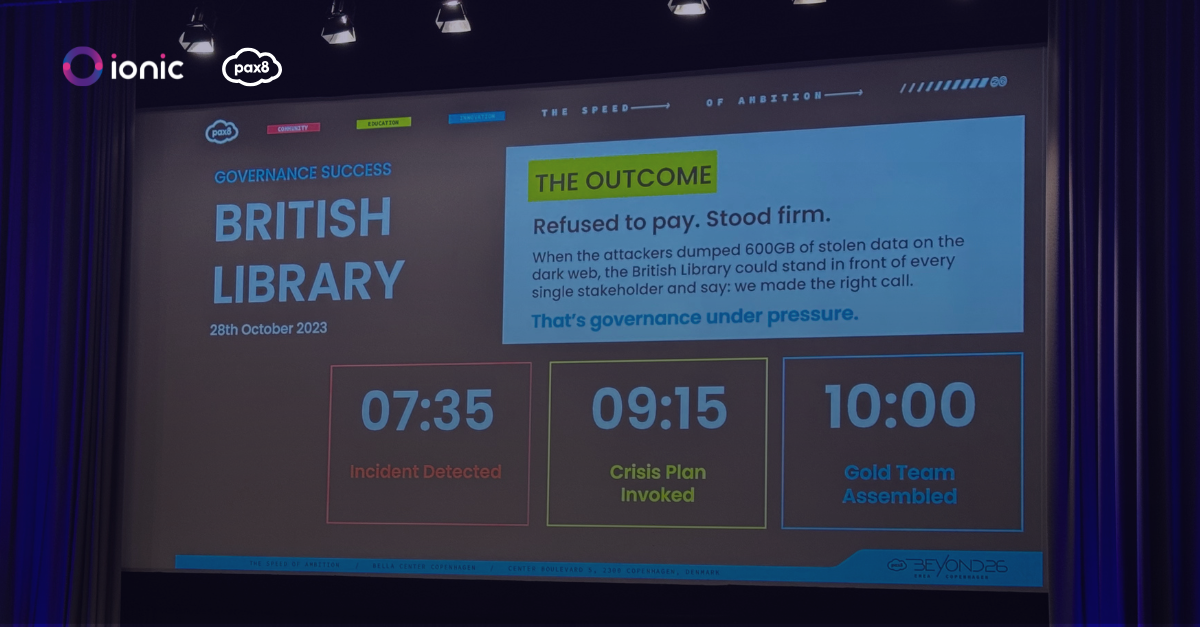
After detecting the cyber incident, the British Library activated its crisis management plan and brought its leadership response team together to coordinate its next steps. With normal systems affected, the team also needed another way to communicate.
The library did not pay the ransom, and the attackers later released stolen data. However, the attack caused disruption to its services, with recovery taking time.
For businesses, this cyber attack response plan example is a reminder to get one in place.
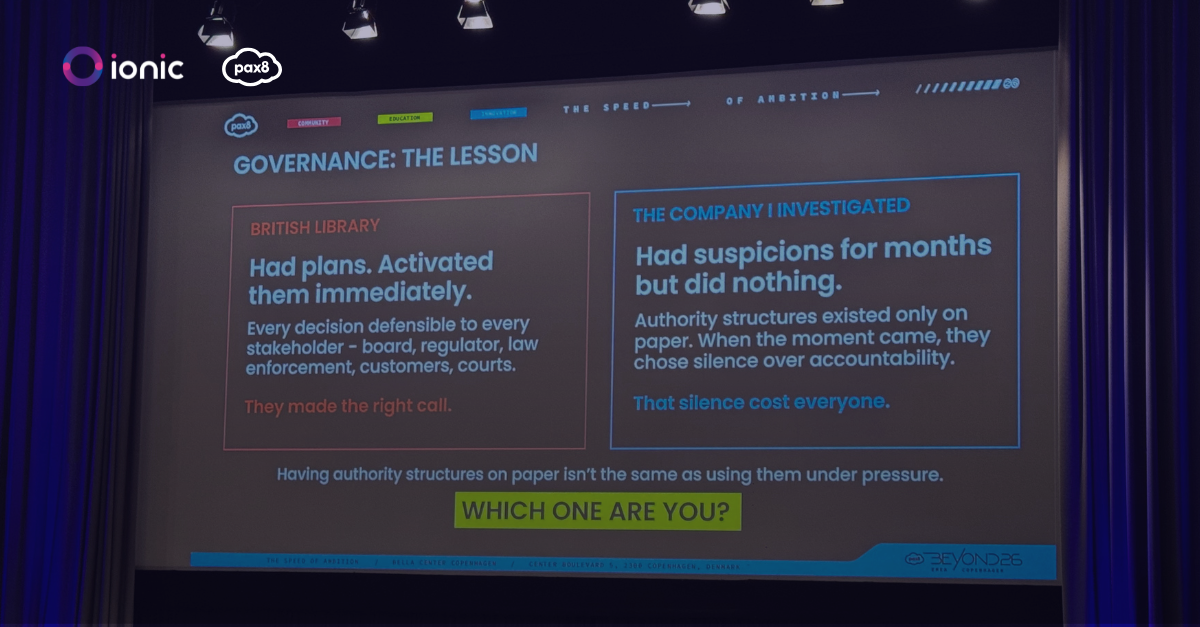
The session also highlighted the value of recording what is known during the cyber incident, what was decided and why, so decisions can be understood and reviewed afterwards. Even a short discussion around a realistic cyber attack scenario can highlight gaps before a real incident happens.
Ionic’s takeaway: Prepare key people in your business on how to respond to a cyber attack. Don’t wait until it happens. Have a written plan in place.
5. Managed IT support should turn IT and security information into action
Businesses now have access to more IT and security information than ever. But an alert or report is only useful if someone understands what it means and takes appropriate action.
A recurring theme at the event was the need to connect visibility with follow-through. If a potential security or IT issue is identified beyond day-to-day IT tickets:
- Who owns it?
- How is it prioritized?
- How does the business know when it has been resolved?
A session led by Paul Redding from NinjaOne considered how bringing IT management information together could help teams connect potential issues with action.
Understand how your business data is backed up
The same thinking applies to business data backups. Knowing that data is in the cloud is a starting point; businesses should speak to their managed IT service provider to understand:
- Data backup arrangements
- What can be restored in the event of a cyber incident or deletion
- Whether recovery has been tested.
At Ionic, we believe managed IT services should be proactive and give businesses confidence that issues are being identified, addressed and reviewed. The same principle applies to business data and file recovery. Know who is responsible for investigating an issue and what happens next is just as important as receiving an alert.
Regular reviews with your managed IT service provider give businesses an opportunity to discuss findings and agree on recommendations for further action alongside day-to-day IT support.
Ionic takeaway: Ask what happens after a cyber issue is identified, not just whether it can be detected.
6. Technology still depends on great people
While much of the Pax8 event focused on technology, there was also a strong emphasis on the people that operate it. One session explored the value of making IT and tech training part of everyday work.
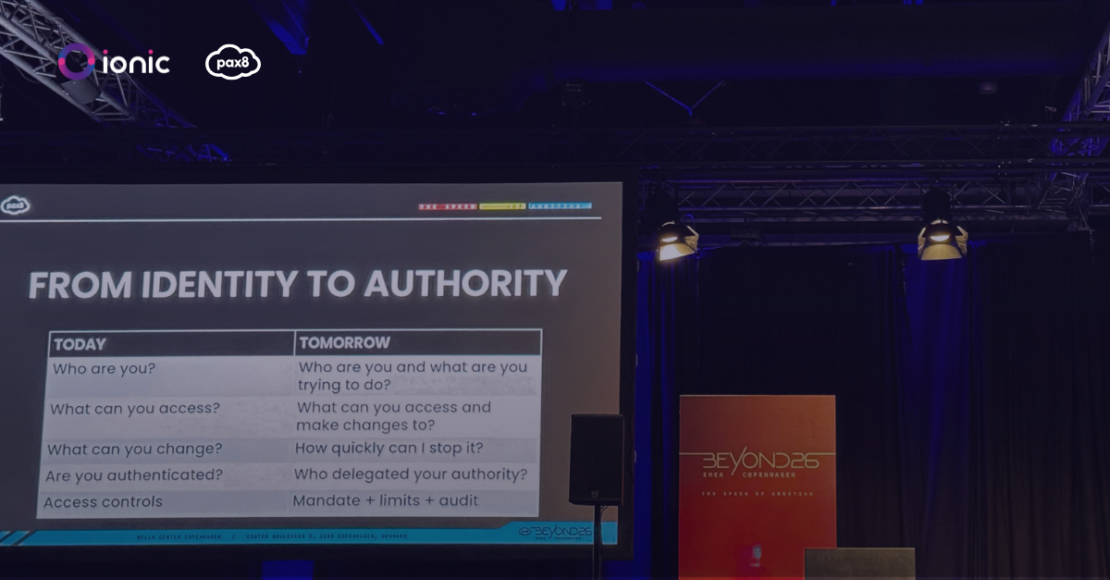
Managed by Strategic Consultants at Pax8, Sophie Dowsett Smith’s, covered a session on training explored practical ways for IT teams to share knowledge during everyday work, including learning from resolved issues and colleagues. This helps staff build confidence and reduces reliance on a single person.
The event closed with a conversation with Peter Schmeichel, former Manchester United and Denmark goalkeeper, about leadership and teamwork. The discussion was a reminder of the importance of:
- Preparation
- Trust
- Understanding the role each person plays in a team.
In a separate 2020 leadership discussion with IMD Business School, Peter Schmeichel reflected:
“The best teams I played in, they had captains everywhere.”
Peter Schmeichel.
Those ideas apply just as much to IT services. Technology changes, but customers still need people they can rely on. People who communicate clearly, take ownership and work together to find a solution to their IT infrastructure.
Ionic’s takeaway: Investing in people and developing their knowledge is an important part of delivering a better Managed IT Service. Which is why Ionic plans to add nine new jobs in 2027, ensuring our clients can speak to qualified, friendly people on their IT plans and problems, instead of a bot.
Managed IT services are evolving to support AI adoption
As businesses explore how to use AI, the role of their managed IT services provider is evolving too, as highlighted at the Pax8 event. Alongside keeping systems secure and supporting staff, IT providers can help businesses:
- Prepare their business information and data for AI
- Identify opportunities to use AI
- Secure AI tools used across the business
- Introduce AI in a sensible way that supports their goals.
The discussions explored how AI could change the responsibilities of IT providers in the years ahead.
In one audience poll, 54% of respondents agreed that managed IT providers may be expected to secure robots and autonomous physical systems by 2030, while a further 37% felt this would be a role for specialist providers.
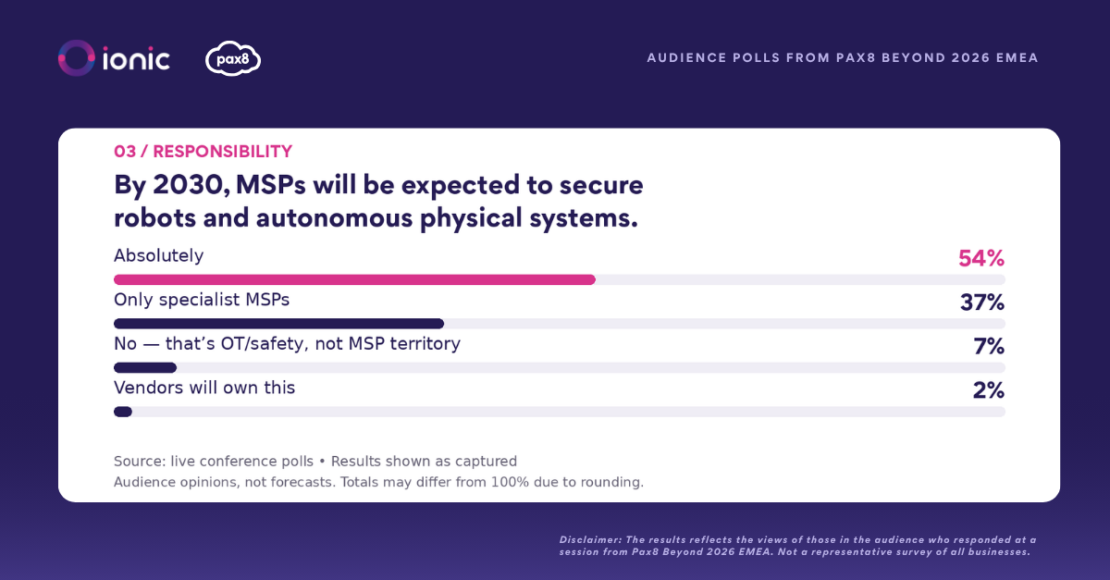
The results reflect the opinions of attendees who responded, rather than a prediction of what will happen. They do, however, highlight how the technology businesses rely on may continue to change.
For many businesses, the first step towards AI adoption is getting the foundations right. Before introducing AI tools that access business information, it’s important to understand where that information is stored, whether it’s up to date and who can access it.
At Ionic, we can help you review your Microsoft 365 environment, including organising and cleaning up information and checking that the right SharePoint permissions are in place. This helps reduce the risk of staff or AI tools accessing information they shouldn’t.
From there, our AI Adoption Strategy Toolkit can help you understand how staff are currently using AI, identify opportunities and build a practical plan.
Once you download your templates from the Toolkit, Ionic’s IT Strategy Consultant can walk you through how to use it for maximum results across your business.
Ionic’s takeaway: The future of managed IT services includes helping businesses prepare for AI, protect their information, and put new technology to work with confidence.
Bringing these IT insights back to Ionic IT
Attending Pax8 Beyond 2026 event was an opportunity to step back from the day-to-day managed IT service world, learn from others across the IT industry, and consider how changes in technology could affect the businesses we support.
For Ionic, we came away with a stronger vision on the future of managed IT services which should combine reliable technology with the right advice, security and human powered expertise.
Whether a business is exploring AI, reviewing its cyber security or planning for growth, the starting point should always be understanding what it needs to achieve and building from there.
Want to discuss any of the themes identified in this article or how Ionic’s Managed IT services can help your business stay secure? Book a complimentary session with Ionic’s IT Strategy Consultant.
Disclaimer: This article is based on information, presentations, discussions, and observations from the Pax8 Beyond event attended by Ionic. The views expressed are Ionic’s own and are provided for general informational purposes only. Quotes and images are used for commentary and reporting purposes.
Don’t just take our word for it…